
Hey mama,
If you’ve been searching for homemaking routines for busy moms and every solution seems to involve waking up at 4 a.m., drinking a suspicious amount of lemon water, and somehow deep-cleaning your baseboards before breakfast… can we just agree that real life rarely works like that?
Because around here, homemaking usually happens somewhere between homeschool math lessons, reheating my hot chocolate milk for the third time, and trying to figure out why the washing machine is suddenly making that sound again.
Realistic homemaking routines don’t usually look Pinterest-perfect.
They look like wiping the counters while your youngest asks seventeen questions in under three minutes. They look like switching laundry while helping with spelling words. They look like doing your best with what this particular day holds.
And honestly?
That’s enough.
For a long time, I thought creating homemaking routines meant finding some magical system that would finally make everything run smoothly.
A perfect schedule.
A flawless checklist.
A color-coded home management plan that would somehow solve all the chaos.
Spoiler alert: it did not exist. What I’ve learned instead is this:
The goal isn’t perfection.
It’s rhythm.
Simple, realistic homemaking routines that help your home function without leaving you completely overwhelmed. Because when you’re balancing housework, homeschooling, meals, laundry, kids, and all the invisible tasks no one notices unless they don’t get done, overwhelm can sneak in fast.
People ask me all the time, “How do you do it all?”
And honestly?
I laugh.
Because I absolutely do not.
Most days, my ducks aren’t in a row.
At this point, I’m not even sure they’re ducks anymore. I’m fairly certain they’ve turned into chickens and are running wild somewhere in the yard.
If you’ve ever looked around at your house, then at your homeschool plans, and wondered how in the world you’re supposed to manage both, you are not alone.
The good news?
Creating homemaking rhythms that work doesn’t require doing more.
It usually means doing less—but doing it more intentionally.
So grab your coffee.
Or chocolate milk, if you’re me.
And let’s talk about homemaking without overwhelm.

Contents
- 1 Why Realistic Homemaking Routines Matter
- 2 Why We Feel So Overwhelmed at Home
- 3 Daily Homemaking Routines That Create Peace
- 4 Think in Rhythms, Not Rigid Schedules
- 5 Homemaking Routines for Homeschool Families
- 6 Teach the Kids to Help
- 7 Build Weekly Homemaking Anchors
- 8 Simple Homemaking Systems Work Best
- 9 Protect Margin Like It Matters
- 10 When the Routine Falls Apart
- 11 Creating Homemaking Routines That Grow With You
- 12 Before You Go
Why Realistic Homemaking Routines Matter
One of the biggest misconceptions about home management is that if your house feels chaotic, you just need to try harder.
Clean more.
Organize better.
Wake up earlier.
Push through.
But realistic homemaking routines aren’t about squeezing more into your day.
They’re about reducing decision fatigue.
When every task requires you to stop and figure out what needs attention next, your brain gets tired fast. That mental load adds up. Simple homemaking systems remove some of that weight. Instead of constantly asking yourself, What should I be doing right now? Your day starts to flow naturally.
Not rigidly.
Not perfectly.
But peacefully.
And peaceful is sustainable.
Why We Feel So Overwhelmed at Home
I think so much overwhelm comes from treating everything like it carries the same urgency.
The dishes feel urgent.
The laundry feels urgent.
The math lesson feels urgent.
Dinner feels urgent.
That strange smell coming from the fridge? Deeply urgent.
When everything feels equally important, it becomes hard to know where to start. That’s usually when we freeze. Or scroll. Or stand in the kitchen staring blankly at the counters while wondering why we walked in there in the first place. (Happens to the best of us.)
Creating daily homemaking routines helps cut through that noise. It gives your day structure without suffocating it.
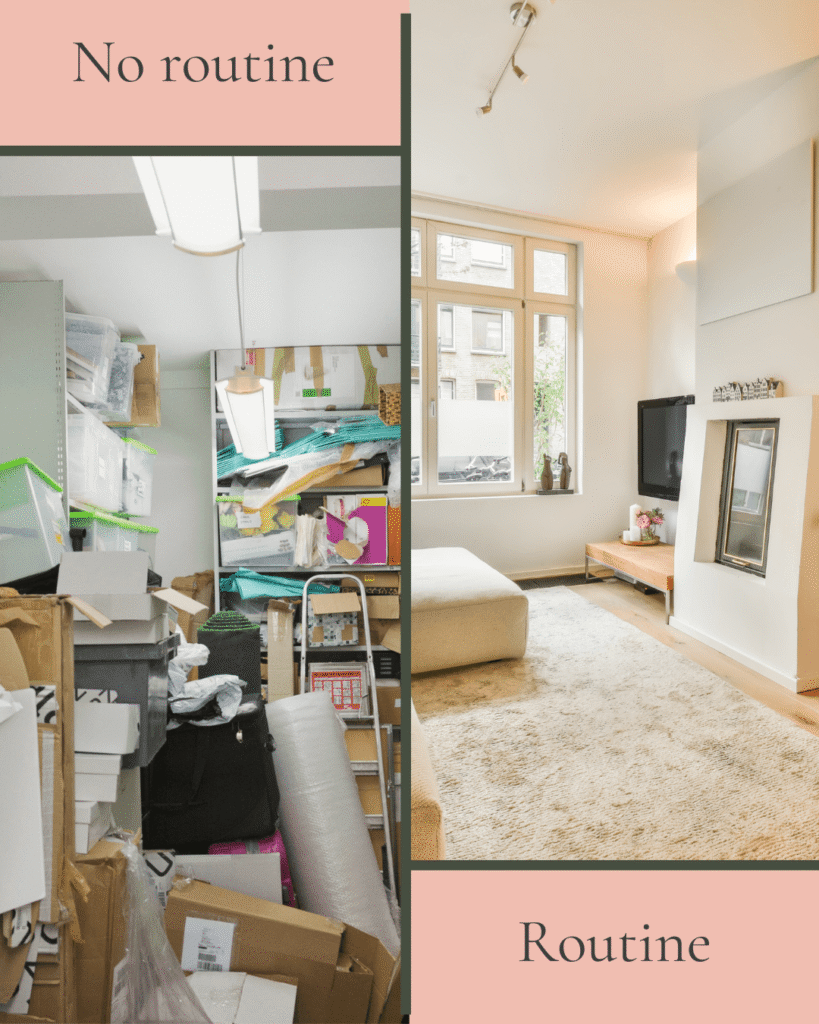
Daily Homemaking Routines That Create Peace
I’ve learned that the way I start my day affects everything that follows.
If the morning begins in panic, the whole day often feels like recovery mode.
That’s why I focus on a few simple rhythms.
Get Yourself Ready First
And no, I’m not suggesting a full glam routine.
Let’s stay grounded here.
I mean:
- brushing your teeth
- washing your face
- getting dressed
Even if “getting dressed” means leggings and a sweatshirt that only has one mysterious stain.
There’s something about getting ready that helps shift your brain into motion.
It says: We’re doing this.
Make the Bed
It takes two minutes.
It instantly makes the room feel calmer.
And if the day completely falls apart, at least one thing looks like it had direction.
That counts.
Choose Three Priorities
One of the best homemaking tips for overwhelmed moms is keeping your expectations realistic.
Not fifteen tasks.
Three.
That’s it.
Ask yourself:
What absolutely needs to happen today?
For me, it might be:
- finish homeschool lessons
- run laundry
- prep supper early
If those happen, the day was productive.
Everything else is extra.
Think in Rhythms, Not Rigid Schedules

Have you ever been to the beach? During a calm day, the waves still come, but they come softly, without hurry, without noise, without the frantic feeling. Having a flexible rhythm means you can ride the waves, even when they get a little rougher.
I’ve never been great at strict time-blocking.
Life with children tends to laugh directly in the face of detailed schedules.
Instead, I think in rhythms.
This flexible daily homemaking routine has been far more sustainable for our family.
Morning: Focus Time
This is when we tackle homeschool and the most important household tasks.
It’s our highest-energy window.
So we use it wisely.
Midday: Reset
This is our pause point.
Water bottles get refilled.
The kitchen gets tidied.
Lunch happens.
Everyone regroups.
It’s amazing what a small reset can do for the rest of the day.
Afternoon: Practical Work
This is when I tackle housework, meal prep, writing, or whatever practical tasks need attention.
Sometimes it’s productive.
Sometimes it becomes “everyone survives until supper.”
Both are acceptable outcomes.
Evening: Set Tomorrow Up Well
I don’t aim for perfection.
I aim for kindness toward tomorrow.
Usually, that means:
- dishes done
- counters cleared
- laundry moving
- floors at least visible
That little bit of evening effort changes the next morning completely.
Homemaking Routines for Homeschool Families
For a long time, I treated homemaking and homeschooling like competing priorities.
If school got done, the house suffered.
If the house got attention, the school felt neglected.
It was exhausting.
Then I realized something:
Home life is part of education.
Cooking teaches math.
Gardening teaches science.
Laundry teaches responsibility.
Meal planning teaches budgeting.
Following routines teaches discipline.
For homeschool families, creating homemaking routines that support learning is far more effective than trying to separate “school life” from “home life.”
The two were always meant to work together.

Teach the Kids to Help
I know.
Teaching kids chores is often slower than doing it yourself.
Sometimes significantly slower.
Sometimes painfully slower.
Sometimes so slow that you question every life choice that led to this moment.
But it’s worth it.
If a child can expertly locate the exact snack they want while ignoring every healthier option in the kitchen, they can probably learn to fold a towel.
Our kids help because they’re part of this home.
Not because chores are a punishment.
Not because they’re earning allowance.
Because families work together.
And yes, sometimes towels come out folded in ways that defy geometry.
We celebrate effort anyway.
Build Weekly Homemaking Anchors
Daily rhythms keep the house moving.
Weekly anchors keep it manageable.
For us, Mondays are reset days.
That usually means:
- sheets and towels
- bathrooms
- vacuuming
- catching up on anything neglected over the weekend
Batching similar tasks helps too.
If I’m already cleaning one bathroom, I may as well clean the others.
If I’m cooking, I double the recipe and freeze half.
Future me deeply appreciates these moments of ambition.
Simple Homemaking Systems Work Best
The best homemaking routines for busy moms are usually the simplest ones.
Not because they’re impressive.
But because they’re sustainable.
A simple homemaking system gives you something to return to when life gets messy.
And life will get messy.
Children get sick.
Plans change.
The dog throws up on the rug five minutes before the company arrives.
Normal things.
The simpler your rhythms, the easier they are to return to.
And if you have children, you already know that “second breakfast” is absolutely a real event that must somehow be factored into all home management systems.

Protect Margin Like It Matters
Because it does.
If every minute is accounted for, burnout isn’t a possibility.
It’s a guarantee.
One of the most important realistic homemaking routines I’ve ever built is quiet time.
After lessons, everyone spends an hour resting, reading, or playing quietly.
And no, I don’t usually use that time to catch up on chores.
Usually.
Sometimes I read.
Sometimes I sew.
Sometimes I just sit in glorious silence and remember I’m a person.
That margin changes everything.
Rest isn’t laziness.
It’s stewardship.
When the Routine Falls Apart
Because sometimes it will.
Someone gets sick.
The day derails by 9:14 a.m.
The toddler “helps” with something.
The washing machine makes that sound again.
This does not mean your routines failed.
It means life happened.
On those days, I return to the bare minimum:
Make the bed.
Run the dishwasher.
Feed everyone.
Try again tomorrow.
That’s enough.
The best daily homemaking routine is one that bends without breaking.

“For God is not a God of disorder but of peace.”
— 1 Corinthians 14:33
I come back to this verse often. Peace isn’t found in perfectly executed systems. It’s found in inviting God into the ordinary rhythms of our days. The dishes. The lesson plans. The laundry. The trying again.
He is present in all of it.
Creating Homemaking Routines That Grow With You
Creating homemaking routines that actually work takes time.
You’ll adjust.
Refine.
Change things as your season shifts.
That’s the beauty of realistic homemaking.
It grows with your family.
Whether you’re building a daily homemaking routine for the first time or simply trying to create more peace in your home, remember this:
Small rhythms build strong homes.
Before You Go
If your home feels overwhelming right now, start smaller than you think you need to.
Choose one rhythm.
Just one.
Make the bed.
Run the dishwasher every night.
Plan supper before noon.
Start there.
You do not need a perfect system.
You just need rhythms that help your home breathe again.
And mama?
If your ducks currently look more like escaped chickens, you’re in very good company.